


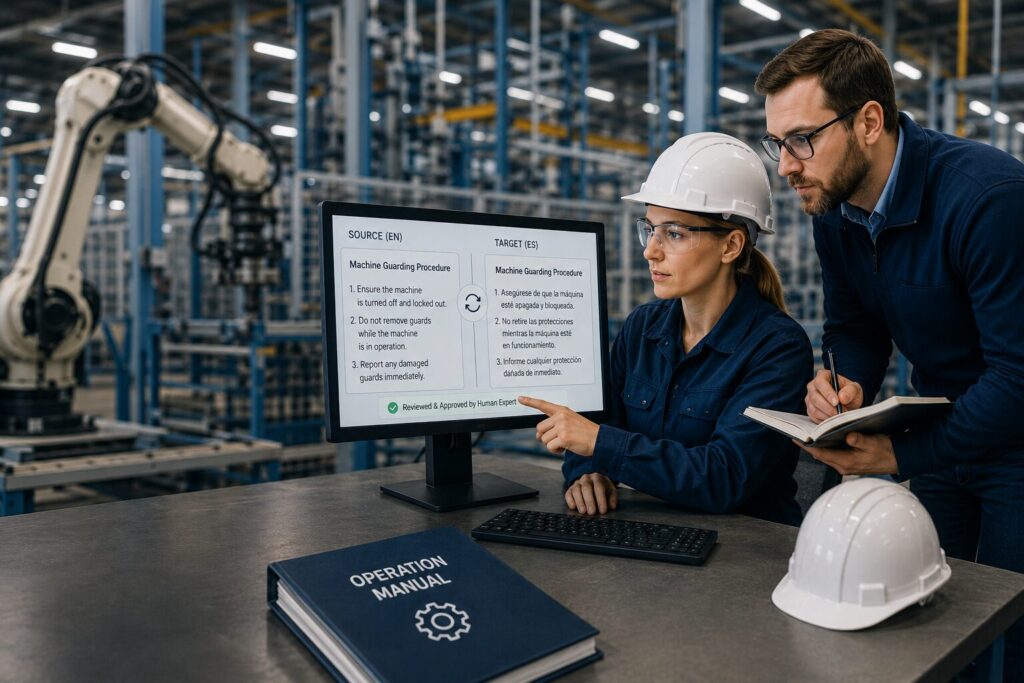
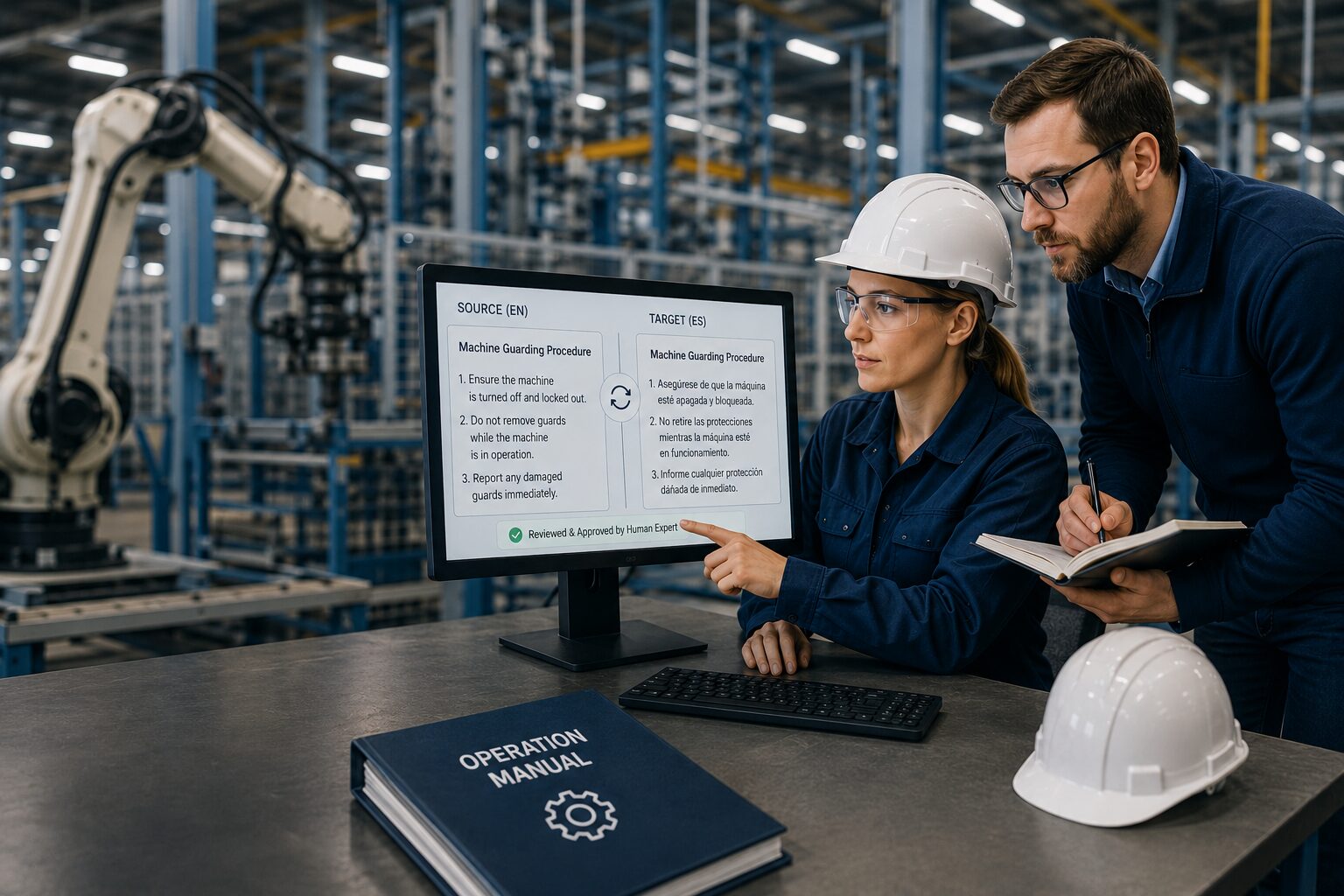
What happens when a single mistranslated word in a technical manual leads to a multi-million dollar product recall or, worse, a preventable workplace injury? In the high-stakes world of industrial software localization services, this isn’t merely a hypothetical dilemma or a cautionary tale – it is a documented liability that has cost corporations their reputations and their bottom lines. As supply chains become more interconnected and products more complex, the margin for linguistic error has effectively shrunk to zero.
As manufacturers race to digitize and globalize their operations, many are turning toward Artificial Intelligence (AI) and Machine Translation (MT) as a “silver bullet” to handle massive volumes of technical documentation and software strings. While AI offers undeniable speed, relying on it exclusively creates a dangerous “silent error” gap. These AI translation limitations in manufacturing exist because AI operates on statistical probability, not semantic precision. It chooses the most likely word based on historical data patterns rather than the technically correct one based on specific engineering context. For instance, a “seal failure” in a mechanical context might be mistranslated by AI as the “failure of a stamp” or even an aquatic animal, a nuance that can lead to catastrophic mechanical breakdowns or total system failure if misinterpreted by local maintenance teams on the factory floor.
Navigating the Compliance and Safety Minefield
The risks of automated translation extend far beyond mere terminology; they strike at the heart of fundamental safety and regulatory compliance. A recent study published in the Journal of Medical Systems highlighted a sobering statistic: 21% of global device-use errors are directly attributed to misinterpreted instructions. For manufacturers governed by rigorous ISO, FDA, or OSHA standards, an audit trail of accuracy is not just a preference, it is a mandatory legal requirement. AI, in its current state, cannot certify compliance, nor can it guarantee that a hazard warning carries the necessary legal weight. Only professional manufacturing translation services featuring certified human experts, possessing both linguistic mastery and subject-matter knowledge, can provide the definitive safeguard required to meet these stringent international benchmarks.
Furthermore, the over-reliance on generic, web-based AI tools poses a significant threat to corporate intellectual property. When employees feed proprietary software code, patented manufacturing processes, or sensitive blueprints into public AI models to save time on translation, they may inadvertently leak trade secrets into public training sets. This data becomes part of the model’s collective knowledge, potentially making your company’s “secret sauce” accessible to competitors through future AI-generated outputs.
The Acutrans Advantage: Human-in-the-Loop Localization
At Acutrans, we advocate for a sophisticated human-in-the-loop localization approach to technical content. This methodology goes far beyond simple post-editing; it is a bidirectional feedback loop where human experts actively steer the AI. In this model, the machine handles the heavy lifting of repetitive, high-volume text, while the human expert provides the critical control layer for judgment, cultural nuance, and technical verification. This hybrid model allows manufacturers to capture the unprecedented efficiency of AI, often reducing overall localization costs by 30-50%, without sacrificing the precision that industrial applications demand.
By integrating human expertise directly into your localization workflow, you ensure that your software UI fits every screen size without awkward truncations and that your technical manuals protect every operator, regardless of their native language. We bridge the gap between “translated” and “localized,” ensuring your technical specifications remain intact across every border. Don’t let your global expansion or your brand’s integrity be undermined by the inherent limitations of a machine.
Ensure your technical content is as precise as your engineering and as secure as your most valuable patents. Partner with a team that understands the intersection of technology and human insight. Learn more about our professional manufacturing translation services and localization expertise at https://acutrans.com/