


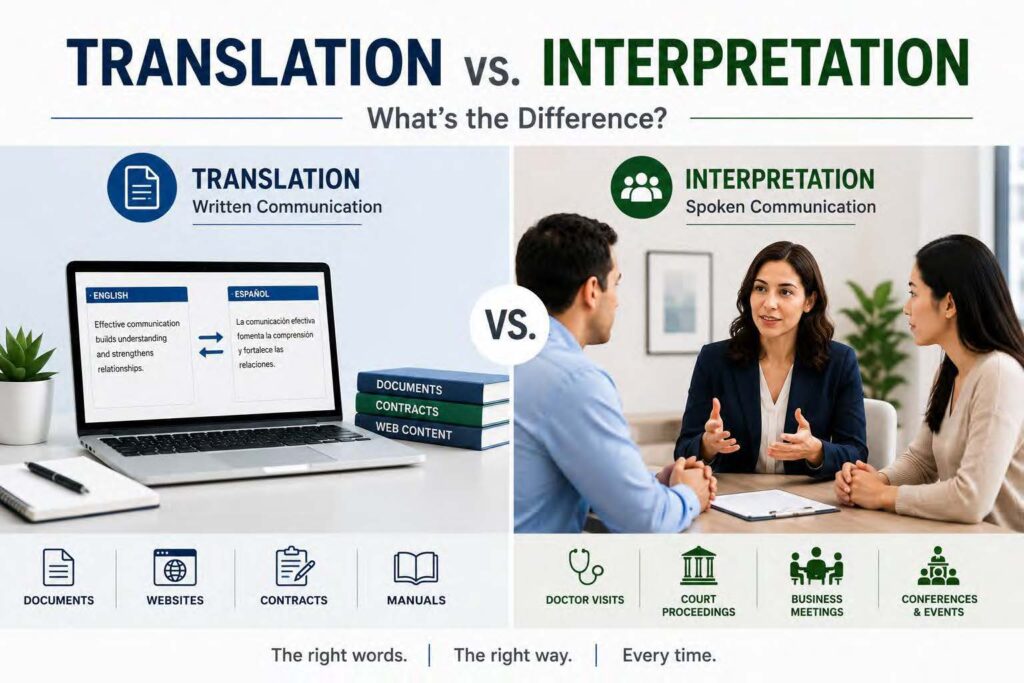
It is not unusual for interpreting and translation to be used interchangeably. While both professions involve converting meaning from one language to another, they are fundamentally different disciplines that require distinct skills, training, and expertise.
Understanding the difference is important because choosing the wrong language service can lead to misunderstandings, compliance issues, and communication breakdowns, particularly in healthcare, legal, and business settings.
What Is the Difference Between Translation and Interpretation?
At the most basic level, translation deals with written content, while interpreting deals with spoken communication.
A translator works with documents, websites, contracts, medical records, marketing materials, and other written content. Translators have time to research terminology, consult reference materials, and carefully review their work before delivering a final product.
An interpreter, on the other hand, facilitates live conversations. Whether assisting during a medical appointment, legal proceeding, business meeting, or conference, interpreters must accurately convey the speaker’s meaning, tone, and intent as the conversation unfolds.
The difference is like writing an article versus delivering a live speech. Both involve communication, but the skills required are very different.
Can Anyone Who Is Bilingual Be an Interpreter?
Many bilingual individuals are surprised to learn that fluency alone does not qualify someone to be a professional interpreter.
Being bilingual means a person can communicate in two languages. Interpreting requires much more. Professional interpreters must be able to listen actively, retain information, process language quickly, convey meaning without adding or omitting information, manage cultural differences, remain neutral, and apply specialized terminology in fields such as healthcare, law, education, and business.
A bilingual person may understand what is being said, but an interpreter must accurately reproduce that message while the conversation continues.
Why Professional Interpreters Need Specialized Training
Professional interpreting requires formal training because the role involves much more than language conversion.
Interpreters develop advanced listening, memory, and note-taking techniques that help them accurately communicate lengthy or complex conversations. They also receive training in ethics, confidentiality, interpreting techniques, cultural competency, professional conduct, and industry-specific terminology.
This expertise is especially important in high-stakes settings. During a medical appointment, an interpreter may need to accurately communicate symptoms, medications, and treatment instructions. In legal proceedings, even a small error can affect a person’s rights or the outcome of a case.
For these reasons, organizations often rely on trained and certified interpreters rather than bilingual employees, family members, or friends.
The Risks of Assuming Anyone Can Interpret
Assigning interpreting responsibilities to an untrained bilingual employee may seem convenient, but it can create significant risks.
Without formal training, interpreters may omit important information, misunderstand technical terminology, lose neutrality, or fail to maintain confidentiality. These mistakes can affect communication, compliance, and trust.
Professional interpreters are trained to facilitate conversations accurately and impartially while preserving the speaker’s intended meaning.
Choosing the Right Language Service
Understanding the difference between translation and interpreting helps organizations choose the right solution.
| If you need… | You need… |
| Contracts, websites, or patient forms | Translation |
| Medical appointments | Interpretation |
| Court hearings | Interpretation |
| Business meetings or negotiations | Interpretation |
| Employee handbooks | Translation |
Final Thoughts
Translation and interpreting share a common goal: helping people communicate across languages. However, they are separate professions that require different skills and expertise.
Speaking two languages does not automatically make someone an interpreter. Professional interpreters undergo specialized training to facilitate accurate communication in situations where precision matters.
If your organization needs translation, interpreting, or both, Acutrans can help you determine the right solution.
Contact us to learn more about our language services.