


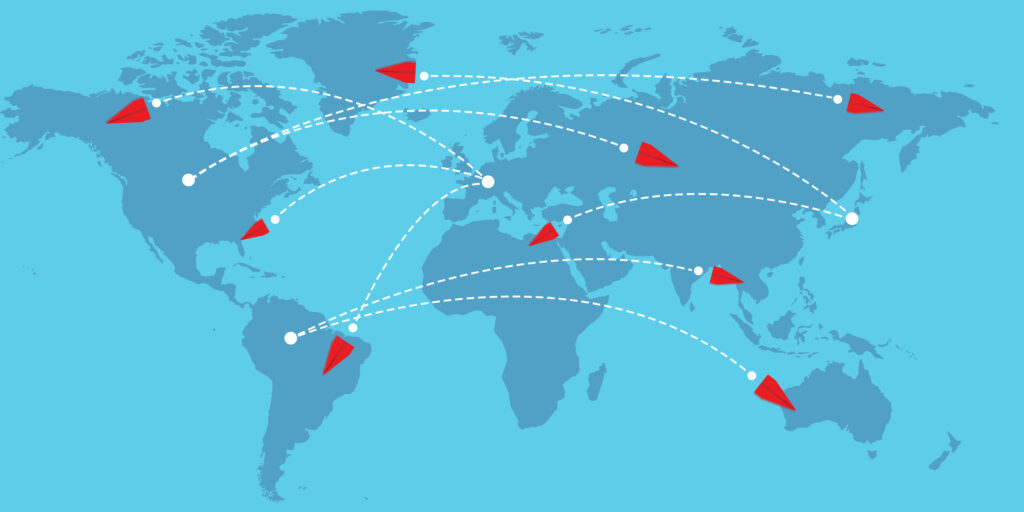
Walk into any public hospital or school district in the United States today, and you will hear the country’s changing soundtrack: Spanish in a hospital’s waiting room, Haitian Creole at a family enrollment fair, Dari and Pashto at a vaccination clinic, Mixteco at a parent and teacher conference. Migration Maps illustrate how migration does not just move people; it moves
languages into new contexts. For a deeper understanding, consider how Migration Maps reveal linguistic shifts across communities.
For language access leaders, the shift is reshaping operations: which languages we prioritize, how we staff, and what “quality” must look like when the stakes are clinical safety or a child’s learning trajectory. Language translation (written) and interpretation (spoken) are both in scope, and both are being leveraged in new, high-impact moments
where clarity, timeliness, and cultural nuance significantly influence outcomes. Migration Maps help organisations anticipate needs more strategically.
The demand picture: big numbers, different needs
Roughly 25 million U.S. residents are Limited English Proficient (LEP), accounting for approximately 9% of the population, which drives demand for language translation access across various sectors, with particularly high needs in healthcare and K-12 schools.
In education, 5.3 million public school students (10.6%) are classified as English Learners (ELs), a decade-long trend that is reflected in everything from enrollment forms to Individualized Education Program (IEP) meetings. Spanish remains dominant, but Arabic, Chinese, and Vietnamese are significant in many districts, and smaller
language communities are growing. Suburban and rural districts that historically served few ELs now face sudden surges.
On the health side, the language mix is increasingly diversified. Spanish still leads, but the need for Chinese, Vietnamese, Arabic, and Tagalog is persistent, and demand for Haitian Creole, Portuguese, Dari, and Pashto has expanded in several metro areas. Therefore, Migration Maps can help visualise and plan for these ongoing changes.
Why migration currents matter for your language plan
The past decade’s migration has reshaped U.S. language demand in four clear waves, and one often overlooked dynamic:
- Hemispheric shifts from Latin America and the Caribbean: Spanish remains core, but Haitian Creole and French have surged in popularity among Haitian migrants in some cities, alongside Portuguese with arrivals from Brazil. These communities often cluster by neighborhood, creating hyperlocal spikes that
overwhelm ad hoc staffing. - Post-conflict resettlement: Following the Afghanistan evacuation, demand for Dari and Pashto surged across healthcare, education, and community support services. More recent arrivals from Ukraine, Venezuela, and the Horn of Africa are now driving requests for languages where interpreter credentials and training
pipelines are still developing. - Indigenous Mesoamerican languages: Communities speaking Mam, K’iche’, Mixteco, and other Indigenous languages increasingly interact with U.S. schools and clinics, often with limited Spanish. Accurate language identification and qualified interpretation, not “closest language available,” become critical safety
issues. - Secondary migration inside the U.S.: Families relocate from initial arrival hubs to places with lower living costs or family ties. Your service area can shift from low demand to a new arrival status in a single semester or during a flu season.
A language access plan cannot be static. It must anticipate and quickly react to changes without compromising quality. That means building flexible teams and (re)defining quality standards.
Key operational plays
1) Map your language mix regularly. Utilize document intake logs, website and app analytics, and interpreter requests to update your Top 10 and long-tail languages.
2) Build a two-tier rare language strategy.
- Tier A high frequency: in-market resources, service level agreements SLAs, style guides, and maintained translation memories and termbases.
- Tier B lower frequency and emergent: rapid response vendors, on demand over the phone interpreting OPI and video remote interpreting VRI, templated consent and notifications, and a surge kit for common forms.
3) Define quality for lower-resource languages. Where certification is unavailable or the talent pool is limited, require structured assessments, work samples, domain- specific terminology checks, and training in medical, educational, and ethical standards.
4) Strengthen vendor portfolio. Diversify suppliers by language strength, not just price. Maintain bench depth for top languages and documented handoffs for rare languages. Conduct quarterly performance reviews with fill rates, average connect times, and QA scores by language and modality.
5) Invest in glossaries and style. Create living glossaries for high-impact domains, such as medications, special education, and behavioral health, and align them with a plain language style. For Indigenous languages, document community preferred terms and dialect notes, and designate a cultural advisor when relevant.
6) Privacy and ethics by design. Identify what content can go through machine translation, what requires human review, and what must never leave secure environments.
Where technology helps, and where it does not
Machine translation and AI-assisted tooling can speed low-risk, high-volume content with human review. But for clinical consents, mental health, special education determinations, disciplinary actions, or legal notices, you need qualified humans who can translate effectively. When emerging language groups enter a system, machine
translation quality tends to be lowest in those languages, since they have limited digital data and are not yet well-supported by translation technology.
Measuring what matters
These metrics can help you cut through the noise:
Access speed: First response time for written requests; average language translation turnaround by tier.
Quality: QA pass rates and severity of defects, critical, significant, and minor, by language and vendor.
The bigger picture: bridges, not bottlenecks
Healthcare and education are where language access becomes tangible, where a missed instruction can mean a medication error, or a mistranslated notice can derail a child’s services. If Migration Maps represent the market for translation, our job is to redraw our operational maps just as fast: identify languages accurately, resource them fairly, and
hold the line on quality where it matters most.
The U.S. has always been a multilingual nation, so building robust, culturally responsive language access and translation programs is essential for hospitals and school districts to turn demographic change into better care and learning, rather than confusion and risk. That is good compliance, but more importantly, it is a good community. In summary, smart use of Migration Maps is vital for successful language access planning.
Acutrans provides translation and interpretive services in 300 languages for a diverse range of industries, including healthcare and education, catering to the varied needs of communities with diverse demographics. You can learn more about our services here.